
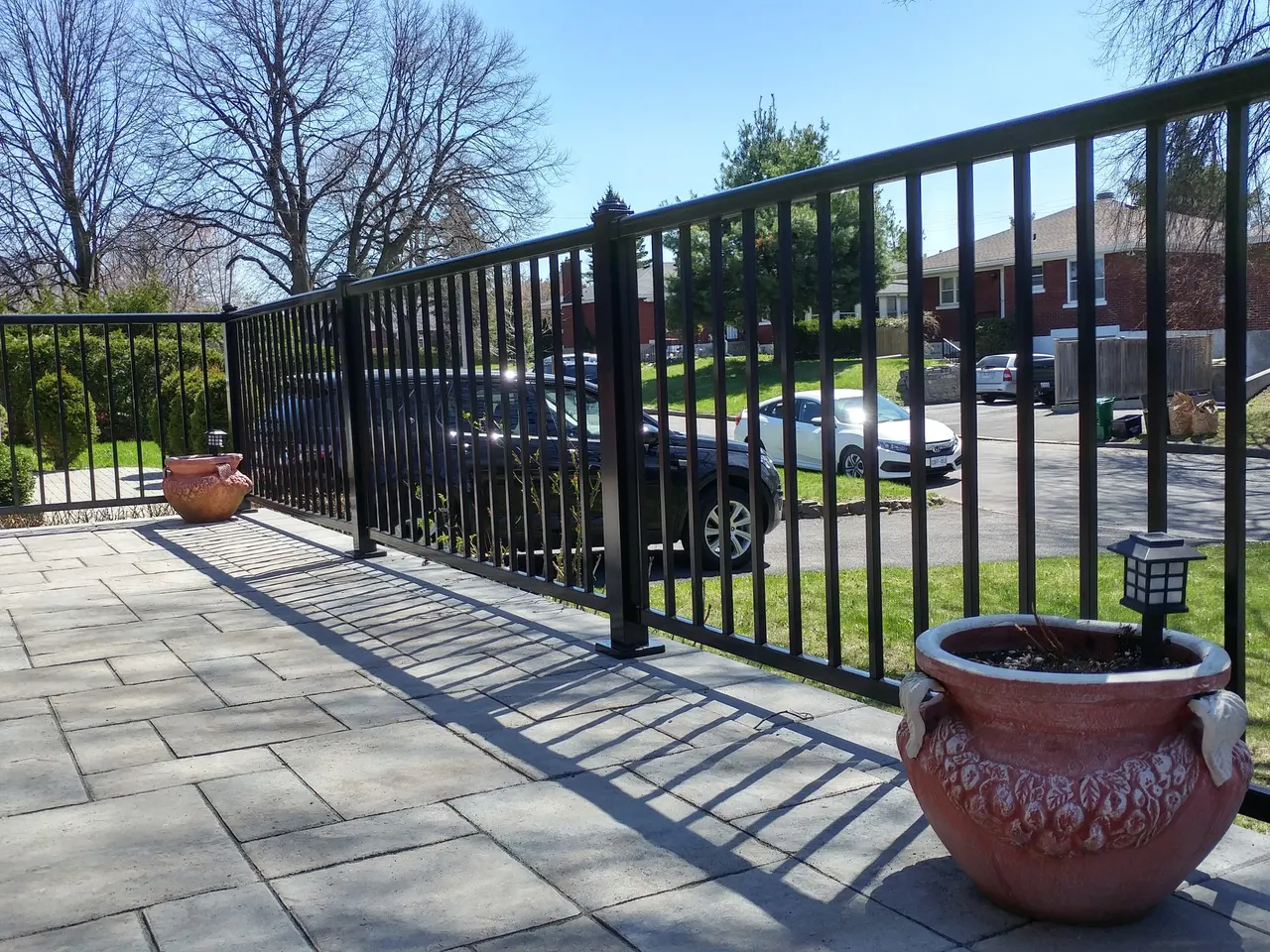
Kanata is one of the busiest parts of our west-end rotation, and it is also one of the least uniform. A hardscaping job on a 1960s Beaverbrook lot and a hardscaping job in a subdivision built fifteen years ago are two different builds, even when the finished patio looks identical in a photo.
Here is what hardscaping in Kanata actually involves, and why the answer depends a great deal on which Kanata you live in.
What hardscaping covers
Hardscape is the built, hard-surface side of a property: patios, walkways, driveways, pool surrounds, steps and retaining walls. It is the structure everything else gets arranged around — the lawn, the beds, the planting. Most Kanata projects are some combination of a backyard patio, a front walkway and, where the grade calls for it, a wall. The full scope is on our hardscaping service page, and the local version on our Kanata hardscaping page.
The two Kanatas, and why it matters underground
Kanata was a separate municipality before amalgamation, and it grew in distinct waves. That history is still visible in the ground.
Beaverbrook and the older core date to the 1960s and 1970s. These lots have mature trees, established grading, and soil that finished settling a long time ago. The complication here is usually root systems and drifted grade — decades of soil being added to beds, downspouts relocated, and water finding new paths. The work often starts with correcting where water goes before anything decorative happens.
The newer subdivisions on the south and west edges are a different problem entirely. Much of that ground is engineered fill placed during development, and fill keeps settling for years after the builder is gone. It does not settle evenly. A patio built on a thin base over ground that is still moving will show every dip within a few seasons, and no amount of quality pavers on top fixes a base problem underneath.
That is why we do not quote a standard base depth over the phone for a Kanata lot. We want to see what is under the topsoil first.
Why the base decides everything
In a climate that freezes and thaws repeatedly through the winter, the compacted granular base under a patio is what decides whether it is still flat in ten years. Water that gets into a poorly drained base freezes, expands, and lifts the surface unevenly. Do that a hundred times over a few winters and a beautiful patio becomes a trip hazard.
Base depth and drainage are the worst possible place to save money, because they are the one part of the job you cannot come back and fix without taking the entire surface off. We walk through the reasoning in detail in our base-depth guide.
Patios and walkways
Once the base and drainage are right, the surface is the enjoyable part. Backyard patios in Kanata are often replacements — a deck at the end of its life, a cracked concrete pad, or first-generation interlock that has heaved and settled. Front walkways carry the daily traffic from driveway to door and set the curb appeal for the whole property.
The material choice between modular pavers, large-format slabs and natural stone is mostly about look and budget once the base is sound. Our interlock vs natural stone comparison lays out the trade-offs, and the patio cost guide covers what drives the number.
Retaining walls
Retaining walls come up on Kanata lots wherever there is a real grade change, and they are structural rather than decorative. The usual triggers are a slope that keeps eroding, soil migrating onto a patio or driveway, a grade too steep to plant or mow, or an existing wall that has begun to lean or bulge.
Height, material, drainage behind the wall and — on a genuine slope — geogrid reinforcement all have to be designed for the load rather than eyeballed. A low garden edge and a wall holding back a driveway are not the same build. Because the City of Ottawa does not publish a single public height threshold we can point you to, our standing advice is to confirm the requirement with City Building Code Services at 613-580-2424. Our permits guide covers this in more depth.
The contractor licence
One piece worth knowing as a homeowner: since March 1, 2026 the City has required the contractor doing hardscaping to hold a municipal Hardscaping Contractor licence. It covers driveways, walkways, patios, retaining walls and steps. The takeaway is one line — ask any contractor to show their licence before you sign. ALM holds an active one.
Planning a project in Kanata?
The design that comes before the build, and how a Kanata lot gets zoned, is in landscape design in Stittsville and Kanata. Renovating inside as well? Home renovations in Kanata covers what Beaverbrook, Bridlewood and Morgan’s Grant houses each need, and why the interior work should come first.
We work the Kanata area on a regular weekly rotation, so quoting and start dates stay quick. If the project extends beyond hard surfaces into planting, grading and lawn, our Kanata landscaping guide covers that side, and hardscape or softscape first covers the order the two should go in and how the budget usually divides. Tell us what you are picturing and we will come walk the lot, dig a test hole, flag the grading and drainage realities honestly, and send a written, fixed-price scope. Book a free on-site estimate and we will measure and price it for you.
Published July 26, 2026 by ALM Construction & Landscaping. General information for Ottawa-area homeowners, not a substitute for the City's determination on your specific project.