
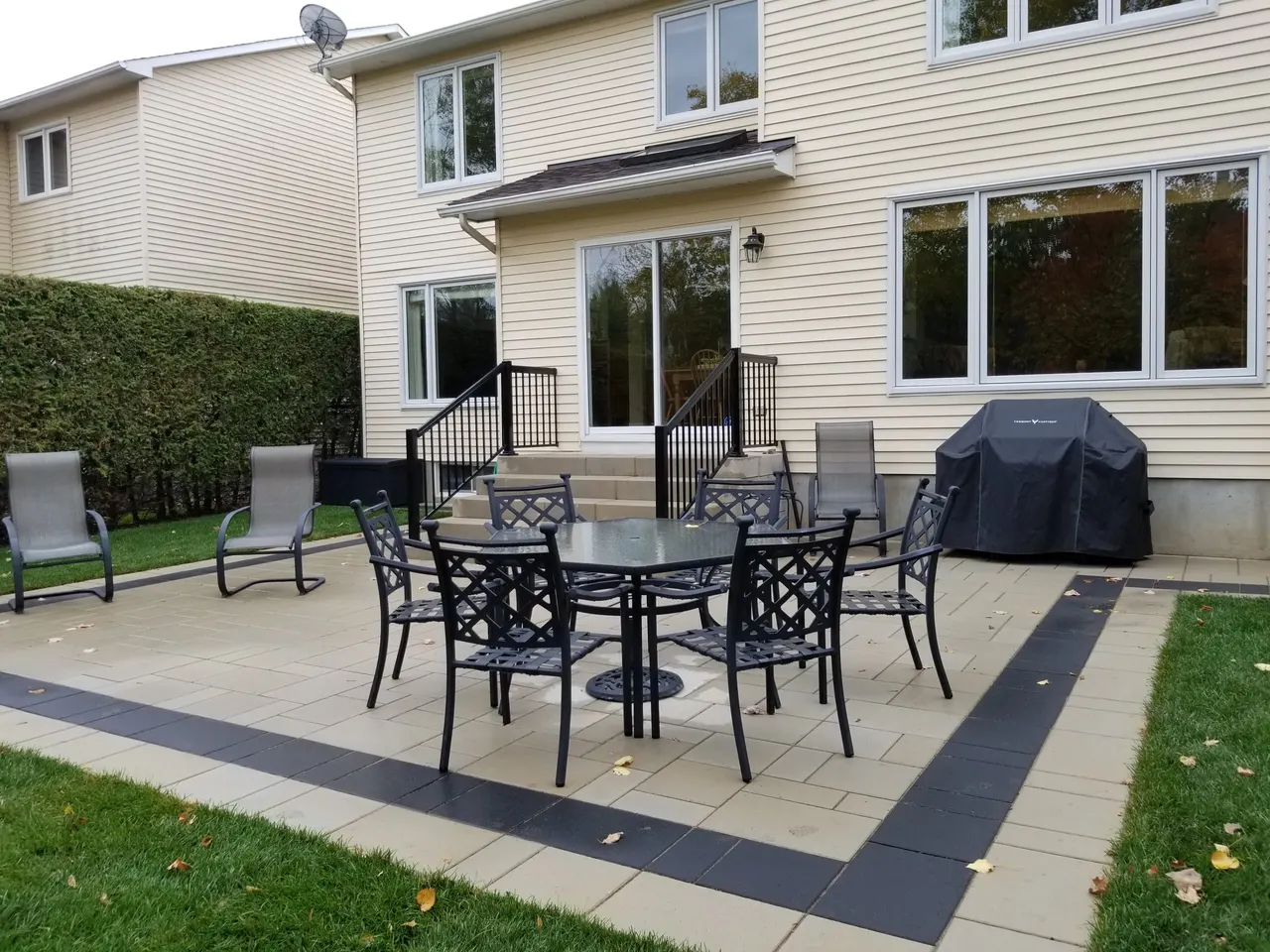
Almost every failed patio we’re called out to fix in Ottawa failed the same way, and it’s never the pavers. The stones on top are usually fine. What moved is the granular underneath, because someone made it too shallow, skipped the compaction, or laid it straight onto clay with nowhere for the water to drain. Run that through forty freeze-thaw cycles a winter and the surface tells on the base.
The textbook minimum
The Interlocking Concrete Pavement Institute sets the floor the trade designs to. Over well-drained soils, ICPI Tech Spec No. 2 calls for a compacted aggregate base of at least:
- 4 inches (100 mm) for pedestrian patios
- 6 inches (150 mm) for residential driveways
The base goes down in 4–6 inch (100–150 mm) lifts, each one compacted to at least 98% standard Proctor density (ICPI Tech Spec No. 2).
Read the qualifier again: well-drained soils. Most of the Ottawa area isn’t well-drained soil.
Why Ottawa needs more
Two local facts push the real number above the textbook one.
Start with the cold. Ottawa sits in plant hardiness Zone 5a (Natural Resources Canada), and the Ottawa Valley’s frost line for footings gets cited around 1.4–1.5 m, roughly five feet (Fencescape’s Ontario frost-depth guide). Nobody digs five feet for a patio, and that figure is for foundation footings, not paving. It tells you something else: how hard the ground here lifts when it freezes. A patio rides that movement by sitting on a deep, uniform, free-draining base that lets water escape before it turns to ice and heaves.
Then there’s the clay. Much of Ottawa, Kanata and the newer Barrhaven subdivisions sit on clay or compacted clay fill that holds water like a bathtub. On those lots, local installers go well past the ICPI minimum, commonly 6–12 inches under a patio (Allen Landscaping). That’s field experience rather than a published spec, and it matches what we pull out of the ground every week.
How we spec it
We treat the ICPI minimum as a floor, never a target:
- Patios: a minimum of 8 inches of compacted Granular A, deeper where the sub-grade is clay.
- Driveways and high-load surfaces: 10–12 inches, with a geotextile separation fabric below to keep the clay from working its way up into the base.
- Compacted in lifts, so the whole depth is dense instead of just the top.
- Drainage before depth. We sort out where the water goes first, grading away from the house and adding drains where the lot forces it, then build the base.
On newer Kanata and Barrhaven lots, thin topsoil over compacted clay fill, we overspec the base as a rule. That choice is the difference between a patio that reads true after a decade of winters and a warranty call in year three.
Want your base specced for your actual lot? Book a free on-site assessment and we’ll probe the soil before we design anything.
Published May 5, 2026 by ALM Construction & Landscaping. General information for Ottawa-area homeowners, not a substitute for the City's determination on your specific project.