
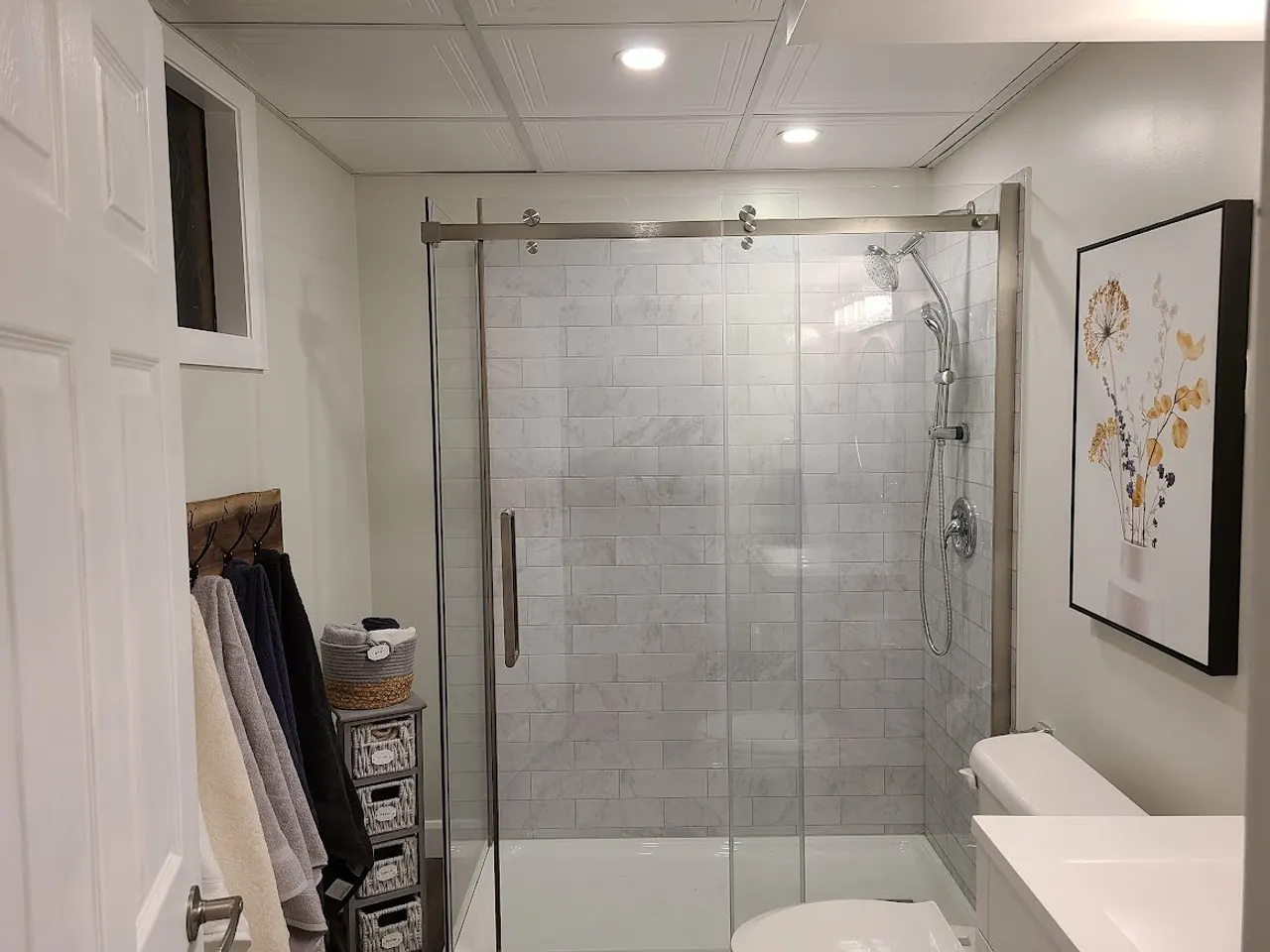
Bathrooms are the smallest rooms we renovate and among the most variable in price. Two Ottawa bathrooms of identical size can differ by a factor of two, and homeowners reasonably want to know why.
It is very rarely the tile.
The first question: does the plumbing move?
This is the single biggest fork in any bathroom quote.
If the new bathroom keeps the toilet, sink and shower roughly where the old ones were, the plumbing work is connection work. The walls and floor stay largely closed, the schedule is shorter, and the price reflects that.
If the layout moves the toilet, the job changes character. A toilet drain is larger than the others and it works on gravity, so it needs a specific fall back to the stack. Achieving that usually means opening the floor and running the drain within the joist space — and joists are structure, so what can be notched or drilled and where is not a free choice.
Sinks and showers are far more forgiving. If you want a new layout but the budget is finite, keeping the toilet in place and moving everything else around it is frequently the compromise that buys you most of the change for a fraction of the cost.
The second question: what is behind the tile?
Bathrooms fail from water, and they fail from the inside.
When we open an older Ottawa bathroom, the common finds are tile set over a substrate that was never suitable, a shower pan that has been weeping quietly into the subfloor for years, and a previous renovation where new tile went straight over old rather than back to a sound base.
None of this is visible on a walkthrough. Some of it is detectable — a floor that flexes, grout that keeps cracking in the same line, a smell that does not clear — but the full picture arrives on demolition day.
This is why we quote bathrooms with a written contingency rather than a flat number that pretends the substrate is fine. A quote without one is not cheaper; it just moves the conversation to the middle of the job, when you have no leverage and no working bathroom.
The third question: waterproofing
This is the part of the price that buys you nothing you can see, and it is the part that decides whether the room is still sound in fifteen years.
A modern wet area is waterproofed as a system behind the tile — the membrane, the way it is lapped, how it is detailed at the corners, the curb and the drain. Tile and grout are not waterproof. They never were. They are the wearing surface over the thing that is.
When a bathroom quote is unusually low, this is the second place to look after the substrate. It is invisible, it is skippable, and skipping it is how a five-year-old bathroom ends up with a rotten subfloor.
Ventilation
Ottawa bathrooms deal with real winter humidity, and an underpowered or badly ducted fan is a slow-motion problem — it shows up as peeling paint, mould at the ceiling line and, eventually, damage in the wall.
The two frequent faults we find are a fan that was never sized for the room and a fan that vents into the attic rather than outside. The second one is worse than no fan at all, because it deposits the moisture somewhere it cannot escape. Both are cheap to correct during a renovation and awkward afterwards.
Where the money is well spent
If the budget has to prioritise, our honest order is: substrate and waterproofing first, plumbing that suits how you will actually use the room second, ventilation third, and finishes last.
That is the reverse of how most bathroom projects get planned, because finishes are the fun part and the part you can see in a showroom. But the finishes are also the only part that can be changed later without opening the walls again.
Getting a real number
We quote bathrooms as a fixed-price scope with the plumbing decision, the substrate contingency and the waterproofing system written out, so you can see which parts of the price are the room you chose and which are the condition of the house.
The full scope is on our interior renovations page, and we work a regular rotation through Nepean, Kanata, Barrhaven and Stittsville. If a bathroom is one of several things the house is due for, where to start with a home renovation covers how we sequence competing work, and what a home renovation costs in Ottawa puts the bathroom range next to kitchens and basements.
If your house is a 1990s–2010s production build, the specific version of this job is in our guide to bathroom renovations in Stittsville and Barrhaven, which covers what is behind a builder surround and the tub-to-shower conversion.
Book a free on-site estimate and we will look at what is actually behind the tile before giving you a number.
Published August 9, 2026 by ALM Construction & Landscaping. General information for Ottawa-area homeowners, not a substitute for the City's determination on your specific project.